
How to Identify Real Ratnagiri Alphonso (and Spot Carbide-Ripened Fakes)
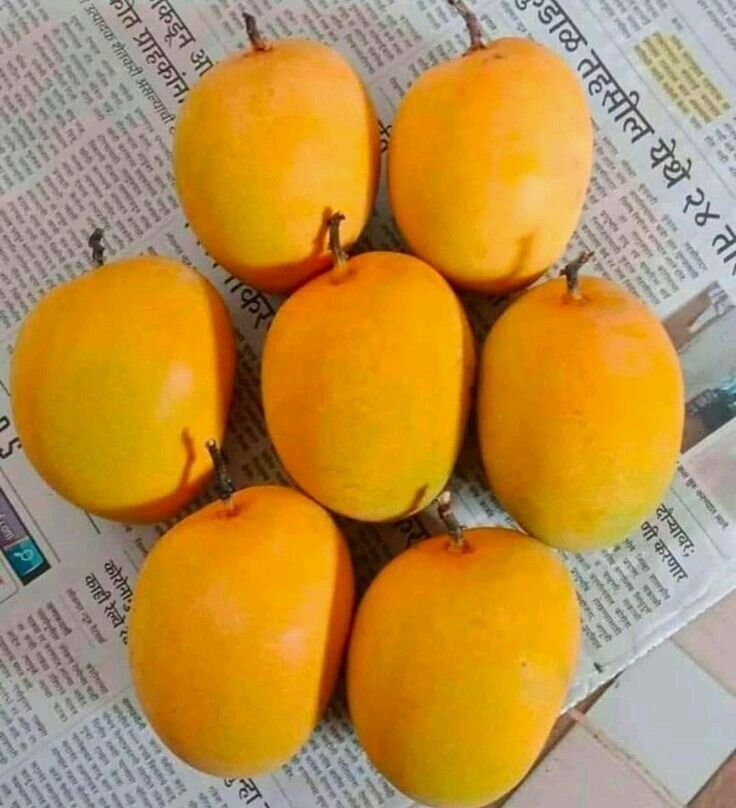
Every April, lakhs of boxes are sold as "Ratnagiri Hapus" and only a fraction of them ever saw the Konkan coast. You do not need a laboratory to tell the difference — your nose, your thumb and one clean cut through the fruit will settle it in under a minute.
We grow and pack Alphonso in the Konkan belt, and the question we get asked most often is not about price. It is some version of: how do I know this is the real thing? What follows is exactly what we look at ourselves when we buy fruit from a neighbouring orchard.
First, what "Ratnagiri Alphonso" actually means
Alphonso is a variety. Ratnagiri is a place — a district on the Konkan coast of Maharashtra, and the historic heart of the Alphonso belt. The variety itself is grown across Maharashtra and in parts of Karnataka, Gujarat and Andhra Pradesh, but the fruit carrying the Geographical Indication is Alphonso grown in the Konkan districts: Ratnagiri, Sindhudurg, Raigad, Palghar and Thane. Lateritic red soil, sea breeze and dry heat before the monsoon are what produce the flavour people are actually paying for.
There are three separate frauds to guard against, and they need different tests: a different variety sold as Alphonso, Alphonso grown outside the Konkan sold as Ratnagiri Hapus, and fruit ripened with calcium carbide rather than naturally or in a legal ethylene chamber.
The shape test: look at the shoulders and the beak
Hold the fruit stem-end up. A genuine Alphonso is an oval slightly flattened on the sides, broadest across the shoulders near the stem, tapering to a rounded rather than pointed base.
The dimple and the beak
At the stem end there is a shallow depression where the stalk sits, and just off-centre from it a small raised nub. In Konkan we call it the nose or beak. On mature Alphonso it is subtle but present, and the stem cavity sits slightly sunken rather than flush. Payri is longer and more clearly beaked at the bottom end. Badami, often marketed as "Karnataka Alphonso", is an Alphonso-type grown on the Deccan plateau and runs larger, more uniformly oval, with less shoulder asymmetry.
Size and weight
Good Konkan Alphonso is a medium fruit. A standard peti of a dozen works out to roughly 2.5 to 3 kg, putting most fruit in the 200 to 275 gram range. Enormous 400-gram "Alphonso" at a bargain rate is almost certainly Badami or Kesar. Big is not better with Hapus; the flesh-to-seed ratio is what you are buying. More on sorting in our piece on harvesting and grading.
The aroma test, and why it is the single best one
This is the test we trust above all others. Cup the fruit in both hands and smell the stem end, not the cheek. A ripe Alphonso pushes out a dense, sweet, almost resinous perfume with a saffron-and-honey quality and a faint turpentine edge underneath. You can smell an open box from the next room, and that is not an exaggeration.
Carbide-ripened fruit smells of almost nothing. The chemical forces the skin to change colour but does not complete the internal biochemistry that produces the aromatic compounds. A mango that is fully, uniformly yellow and yet smells of nothing is the clearest single warning sign you will get.
Buy one fruit before you buy a box. Any honest seller in a market will let you smell the stem end. If a vendor will not let you pick up and smell the fruit, walk on.
Cut it open: flesh colour, fibre and the seed
Cut a ripe fruit along the flat of the seed. Three things should be true. The flesh is a deep saffron-orange, not pale yellow and not the bright carroty orange of Kesar. It is non-fibrous: genuine Alphonso pulp is smooth enough to eat with a spoon, and you should not be picking threads from your teeth afterwards. A few fine fibres immediately against the seed coat are normal, but fibre running through the body of the flesh is not Alphonso. And the seed is noticeably thin and flat, like a papad standing on edge, which is why the fruit yields so much pulp for its size.
Carbide-ripened fruit fails on the inside in a specific way. The ripening is uneven: one part of the flesh soft and sweet while an adjacent part is still hard, whitish near the seed and sour, often with a watery translucent zone under the skin. The fruit has been made to look ripe from the outside inward instead of ripening from the inside outward.
Skin: real farm fruit is not cosmetically perfect
This is where we lose customers, so we would rather say it upfront. Naturally ripened orchard fruit has marks on it: black or brown specks, a faint sooty film, healed scars where a leaf rubbed the fruit in the wind, sap burn near the stem. None of it affects eating quality. Fruit that has been through a real orchard, a bamboo zela, a grading table and a truck is not going to look like a wax apple.
What natural ripening looks like on the skin is a gradient: green at the base fading through yellow-green to blushed golden at the shoulders, often with a rosy tinge where the sun struck, arriving unevenly over several days. Flat, edge-to-edge lemon yellow across an entire crate overnight is not how mangoes ripen. It is how mangoes are ripened.
Calcium carbide versus ethylene: the difference that matters
These two get conflated constantly, and the confusion works in favour of dishonest sellers.
Calcium carbide is a grey, stone-like industrial chemical. On contact with moisture it releases acetylene gas, which crudely mimics the ripening hormone and turns skin yellow fast. It is banned for use on food under India's Food Safety and Standards regulations, and for good reason: commercial-grade carbide carries traces of arsenic and phosphorus. Traders like it because it is cheap and needs no equipment, just a few pouches tossed into a crate under newspaper.
Ethylene is different. It is the plant's own ripening hormone, the same gas the fruit produces itself and the reason a ripe banana ripens everything in the bowl beside it. Ripening in a controlled chamber at low regulated concentrations, or with approved ethylene sachets, is legal within prescribed limits and produces fruit that is genuinely ripe, aromatic and evenly sweet. So do not panic when a good supplier mentions a ripening chamber. Ask instead which gas, and at what stage the fruit was picked, because ethylene only works properly on fruit that was already mature on the tree.
If you ever see loose grey granules, a chalky white powdery residue, or crumbly white lumps in the bottom of a mango crate or wrapped in twists of newspaper, that is spent calcium carbide. Do not buy the fruit, and do not simply wash it — the problem is not only surface residue.
| What you check | Naturally / ethylene ripened | Carbide ripened |
|---|---|---|
| Skin colour | Uneven gradient, green shoulders fading to gold, sometimes a red blush | Flat uniform yellow over the whole fruit, often oddly bright |
| Aroma at stem end | Strong, sweet, fills the room | Faint or completely absent |
| Stem area | Clean, may show harvest sap marks | Dark or black sunken patches near the stalk |
| Feel | Yields evenly to gentle thumb pressure | Soft in spots, hard in others; sometimes yellow but rock hard |
| Inside | Uniform saffron-orange to the seed | Patchy, white or sour near the seed, watery under the skin |
| Crate residue | Paper, hay, dry grass | Chalky white or grey granules, damp newspaper twists |
| Shelf behaviour | Ripens over 4–8 days, then softens gracefully | Turns colour in a day, then shrivels or rots quickly |
Ratnagiri Alphonso and the lookalikes
Ratnagiri Alphonso is grown right along the district’s coastal talukas, and the fruit is typically generous in size with a thin skin and the deep perfume the variety is known for. What matters far more than the district on the label is the orchard behind it — soil, tree age, how the fruit was picked and how quickly it was packed. Orchard-to-orchard variation inside a single taluka can be larger than the difference between two districts, which is why we tell you which orchard your box came from.
The genuine impostors are the other varieties. Kesar has orange flesh but a muskier flavour, a rounder shape and a green tinge that persists when ripe. Payri is longer, more fibrous and arrives earlier. Badami looks closest and is often sold as Alphonso outright, but is milder, larger and smoother-skinned. Totapuri, with its parrot beak, is a pickling and pulping mango. We compare them side by side in our variety guide.
GI stickers, QR codes and price signals
Registered Ratnagiri growers' associations issue GI stickers and QR-coded tags to authorised members. It is a useful system and we support it. It is also, being a sticker, trivially copied, and printed stickers turn up on non-Konkan fruit every season. A QR code is only meaningful if you actually scan it and it resolves to a real grower registration on the association's own domain, not a generic landing page. If it does not scan, it is decoration. There is more on what the tag does and does not certify in our explainer on the GI tag.
Price is the harder signal, and we will not quote numbers because they move week to week. The principle holds regardless: Alphonso is expensive to produce. Trees flower in December and January, fruit is hand-picked from March through May, and yields swing wildly with unseasonal rain and thrips. A rate dramatically below what everyone else is asking that same week means something has been substituted, whether variety, origin, grade or ripening method. Early-season fruit costs the most and late-May fruit the least; the honest rhythm of it is in our season calendar.
What to check the moment the box arrives
Open the peti the same day it is delivered, in good light, before you put it away.
- Smell the open box before touching anything. There should be a clear sweet perfume even from firm fruit.
- Tip out the packing material and look at the base of the box for white or grey granules and chalky dust.
- Count and inspect. A few marked or scarred fruit is normal. More than one or two already soft, leaking or with black sunken patches near the stem is not.
- Check for mixed stages of ripeness. A good consignment ripens over a week, not all on Tuesday. Fully uniform ripeness on arrival is a flag.
- Repack in a single layer with newspaper or hay, at room temperature. Cutting one fruit on day one tells you what the rest will do.
Do not refrigerate fruit that is still firm. Cold arrests ripening permanently and you end up with a mango that never develops flavour. We cover that in this article on refrigerating mangoes.
The oldest test in our family is the simplest. If you cannot smell it from an arm's length away, do not eat it.
Frequently Asked Questions
Is a fully yellow mango always carbide-ripened?
No. Fruit from a legal ethylene chamber, or fruit that has sat several days at home, can be very evenly yellow. Colour alone proves nothing. The carbide signature is uniform colour plus no aroma plus uneven softness.
Does washing carbide-ripened fruit make it safe?
Washing removes surface residue and is worth doing with any fruit, but it does not undo the problem. The fruit was picked immature and forced, so the flesh stays unevenly sweet and poorly flavoured. Better to return the box.
Is Ratnagiri Alphonso better than Alphonso grown elsewhere?
Within the Konkan GI districts it is the same variety, and the good fruit from any of them is excellent. Ratnagiri’s coastal talukas have the longest reputation for it. The bigger difference is between Konkan-grown Alphonso and the same graft planted outside the region, which produces a recognisably milder fruit — and after that, orchard, tree age and harvest timing matter more than the district printed on the label.
My mango has black spots on the skin. Should I throw it away?
Usually not. Scattered black specks and sooty patches are cosmetic and common on orchard fruit. Be cautious about large, sunken, soft black patches around the stem, especially if the fruit smells fermented.
Can I rely on the GI sticker or QR code alone?
Treat it as one signal, not proof. Scan the code and check it resolves to a registered grower on the association's own site, then combine it with the aroma, shape and flesh tests and with whether the seller can name the taluka and orchard.
Order Konkan Alphonso direct from the orchard
Hand-picked, naturally ripened in hay, and packed the day they leave the tree. Message us on WhatsApp for this season's availability and prices.