
Inside a Konkan Orchard: How Alphonso Is Harvested, Graded and Packed
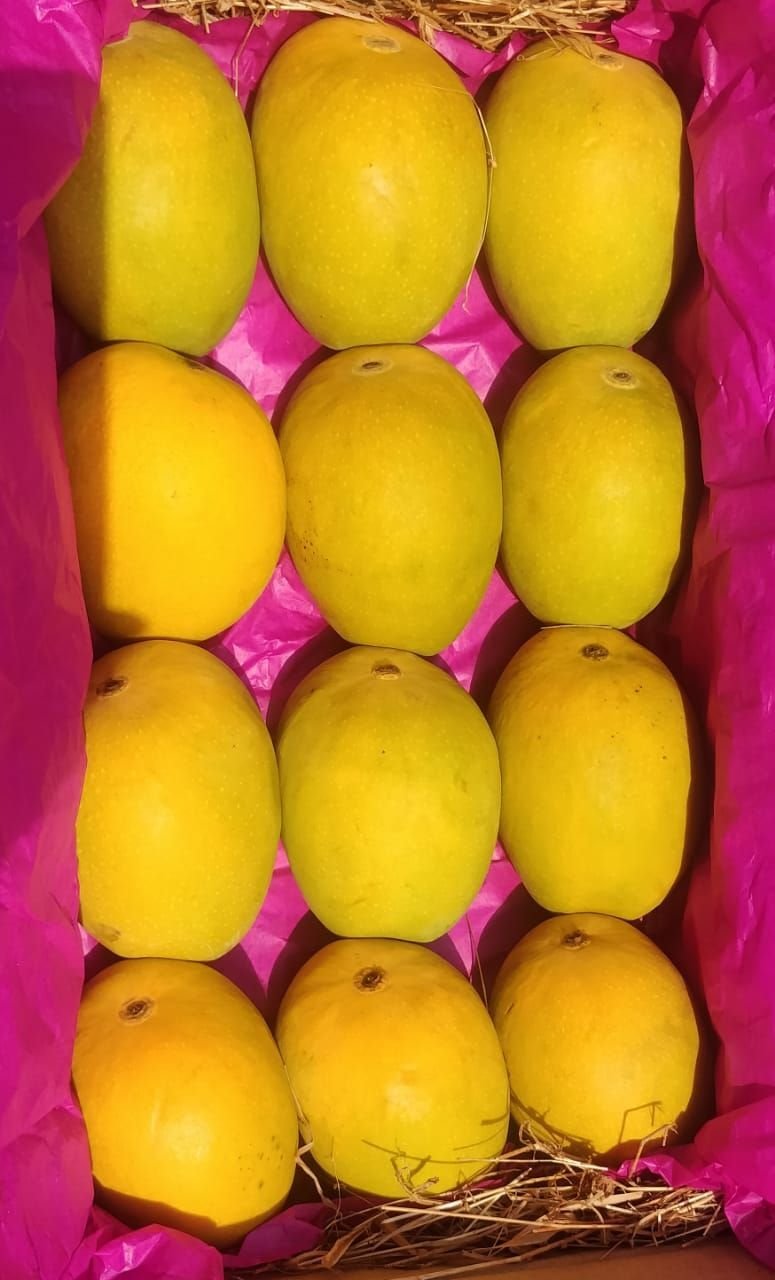
Almost everything that decides whether your Alphonso tastes like Alphonso happens in about seventy-two hours — the day it is cut, the night it drains, and the day it is graded and boxed. Here is what those hours look like in our bagayat, the orchard.
Reading maturity on the tree
The commonest reason a customer is disappointed by Alphonso is that the fruit was picked too early. An immature mango still softens, because softening is largely water and starch chemistry. What it will not do is develop aroma, which builds on the tree in the final stretch and stops for good the moment the stalk is cut. Fruit taken ten days early goes soft, goes yellow, and tastes flatly sweet — sugar water, not Hapus. So maturity is judged, not guessed, on four signals read together.
Days from fruit set
We track each block from mohor, the flowering panicle that carries the blossom. Once fruit sets behind the flower we count — generally around 100 to 120 days in our belt, shifting with the year, the block and the age of the tree. Our trees flower in waves, so one orchard runs three or four clocks at once. That is why the season staggers as it does along the coast, as our month-by-month season calendar sets out.
Shoulder fill and colour break
An immature Alphonso is narrow and even along its length. As it matures the shoulders around the stem end swell until the fruit looks slightly lopsided, with a fuller cheek on one side. At the same time it loses its deep grass green right at the stem cavity, turning creamy-green there while the rest stays dark. That quiet lightening at the shoulder is the tree saying it has finished. Fruit uniformly dark green all over is not ready, however large it looks.
The specific gravity float test
The check we trust most is the simplest. Drop sample fruit into a drum of water. Immature mangoes float high; as starch accumulates and the flesh fills, density rises and mature fruit sinks or floats very low with only a small cap showing. We float a handful from a block and decide whether it opens now or waits five days.
No signal is used alone. Fruit can have good shoulder fill and still be a week short. The judgement is the combination, made block by block rather than orchard-wide.
The zela, and why Alphonso is never shaken down
Alphonso is harvested one fruit at a time with a zela — a long bamboo or aluminium pole with a cutting hook at the tip and a net bag slung beneath. The picker sets the bag under the fruit, cuts the stalk, and the mango falls a few centimetres into the net. Nothing drops to the ground.
This is not fussiness. Alphonso skin is thin and the flesh beneath bruises without showing anything for two or three days. Fruit that falls even a short distance onto hard ground carries an internal bruise that appears as a soft brown patch exactly when the customer is cutting it open. Shaking a tree, or spreading nets and letting fruit rain down, is fine for pulp-grade fruit going to a processing unit. It is not how table fruit is picked. Harvest is a morning job; we stop as the day heats, because afternoon fruit carries field heat into the shed and starts its ripening clock hours early.
The stem, the sap, and the black marks nobody wants
When the stalk is cut, mango latex runs out under pressure, and it is caustic. Let it run down the shoulder and it burns the skin, showing up two to four days later as a black streak radiating from the stem end. The flesh underneath is usually fine, but the box looks damaged, and no customer accepts an explanation on a leaflet.
The prevention is procedure, not chemistry. Fruit is cut with a short stem left on — roughly a centimetre — rather than flush against the shoulder, so sap does not spray at the moment of cutting. At the shed, within a couple of hours, each fruit is de-stemmed properly and set face-down, stem end downward, on slatted trays so latex drains away instead of running across the skin. Liners are changed, because pooled sap finds its way back onto a shoulder. Careless de-sapping is a reliable tell of a rushed supply chain — one of several in our guide to spotting genuine Ratnagiri Alphonso.
Washing, drying and shade curing
Fruit is then washed free of residual latex and field dust, and dried thoroughly. Drying matters more than washing: moisture trapped in the stem cavity or under packing material invites rot, and one rotting fruit in a closed box takes its neighbours with it. It then rests a day in a shaded, ventilated space. That short cure lets late seepage show itself and lets field heat come out, so fruit enters the box at a stable temperature rather than ripening unevenly.
Grading: why a peti is sold by count
A peti is the standard mango box of our coast — traditionally wooden slats, today usually a carton of similar internal volume. The point is that a peti is a fixed space, filled nose to nose so nothing moves, which makes the number of fruit that fit a direct statement about their size. That is why we sell in dozens, and why count is grade. Plainly: a higher count means smaller fruit, not more mango. Grading is by hand against reference fruit with sample weight checks; fruit is pulled for blemish, sap marks and softness, because a peti is only as good as its worst piece.
| Count per peti | Approximate weight per fruit | Typical use |
|---|---|---|
| 2 dozen (24) | Around 275–350 g | Gifting, corporate boxes, showpiece fruit |
| 3 dozen (36) | Around 225–275 g | Gifting and family eating |
| 4 dozen (48) | Around 175–225 g | The common household box |
| 5 dozen (60) | Around 150–175 g | Daily eating, larger families, aamras |
| 6 dozen (72) | Around 125–150 g | Aamras, pulp, bulk use |
Size is not flavour. A well-matured 5-dozen fruit off an old tree beats a rushed 2-dozen fruit every time.
What spongy tissue is
Spongy tissue is an internal disorder specific to Alphonso, and a genuine frustration because it cannot be seen from outside. Cut such a fruit and part of the flesh, usually near the stone towards the stem end, is pale, corky and flat or slightly sour while the rest is normal. It is physiological, not an infection or a pest. Growers here associate it with heat stress in the last weeks on the tree and fruit left to go over-mature, which is why the same orchard can have a clean year and a troublesome one with no change in practice. Cool-morning harvest and shade curing reduce it; nobody can guarantee it away, because there is no external symptom to grade against.
Packing: gawat, paper and the box
Traditional Konkan packing uses gawat — dry grass or hay. It works remarkably well: breathable, mildly absorbent, holding fruit apart without pressing on it. For longer journeys each fruit is wrapped in soft paper and set in a moulded tray, one layer per level. The rules are the same either way: fruit must not touch fruit, must not shift when the box is tilted, and air must move. Cartons are ventilated and their walls chosen for stacking load, because a mango box is crushed from above, not by handling.
Open the box the moment it arrives and take the fruit out of the packing. Boxes protect fruit in transit; they are not storage. Ripening mangoes give off heat and gas, and a closed box accelerates everything unevenly.
Why farm-direct fruit ships raw
Alphonso is harvested mature but unripe and ripens off the tree, so farm-direct fruit ships raw — and should. A mango already soft when packed will not survive two or three days on the road. The alternative is force-ripening so fruit looks attractive on arrival; with controlled ethylene in a chamber that is legitimate, but done the cheap way with calcium carbide thrown into a box it is both illegal in India and destructive, giving uniform yellow skin over flesh that never developed. We pack raw, say roughly how many days the fruit needs, and let it finish in your kitchen. What it goes through in between is covered in our guide to how mangoes travel across India.
Three routes to market, and what each one costs
Orchard-direct
The grower grades, packs and ships. Fruit is boxed within a day or two of being cut and never changes hands again. The grower carries packing, courier and customer-service costs but keeps margin that would otherwise be split several ways. The buyer's gain is time — fewer days between tree and door means more shelf life left at your end.
APMC mandi
The traditional route sends fruit to a regulated market, for Konkan Alphonso most famously the APMC market at Vashi in Navi Mumbai. Fruit moves overnight, sells through auction or a commission agent, and is bought by wholesalers who supply retailers. It is genuine price discovery and clears volume fast, which matters in a short season. The trade-offs: the grower's realisation is net of commission and market charges and is set by that morning's arrivals rather than by his own fruit, and the mango collects extra days and extra hands before it reaches a shop.
Aggregator resale
A platform or reseller buys graded fruit — sometimes from growers, often from the mandi — repacks it under its own brand and sells online. The buyer gets convenience; what is obscured is age and origin, since branding is applied after grading, so farm-fresh fruit may have been bought wholesale two days earlier. That is where a good deal of premium-labelled Konkan fruit acquires its name; the GI tag protects the region's name but cannot police every carton.
The labour reality of an eight-week season
All of this happens inside roughly eight to ten weeks, and that single fact shapes the business. Trained pickers are the constraint: reading maturity, working a zela at height and cutting the right stem length are not learned in a day, and everyone who can do it is wanted by every orchard in the same fortnight. Shed hands, graders, box carpenters and drivers are needed at once and idle the rest of the year. Many of our workers return season after season, which is worth more than it sounds — a picker who knows a block knows which trees run early. Weather compresses things further: unseasonal rain or a heat spell can force a block to be harvested in three days instead of ten, and grading becomes the bottleneck. It is also why farm-direct sellers close orders when they close them rather than promising fruit into June.
A mango is not made in the packing shed. It is made on the tree, and everything after harvest is an exercise in not spoiling what the tree already did.
Frequently Asked Questions
Why does my Alphonso have black marks near the stem?
Almost always sap burn from poor de-sapping. Latex is caustic, and if it runs down the shoulder instead of draining with the fruit face-down, it scars the skin over the following days. The flesh underneath is usually fine.
Does a higher dozen count mean I get more mango?
No. A peti is a fixed volume, so the count tells you fruit size. A 6-dozen box holds seventy-two small mangoes; a 2-dozen box holds twenty-four large ones. Choose the count by the size of fruit you want.
Why is my fruit rock hard when it arrives?
Because it should be. Alphonso ripens off the tree, and fruit soft enough to be pleasant on arrival would have been damaged in transit. Take it out of the box, keep it warm, dark and airy, and let it come along over a few days.
Can spongy tissue be spotted before cutting?
Not reliably. It has no external symptom, which is why even careful growers occasionally send an affected fruit. Cool-morning harvest and shade curing reduce it, but nobody can grade it out by eye.
Is mandi fruit worse than orchard-direct fruit?
Not inherently — excellent fruit passes through Vashi every day. The difference is age and traceability: mandi fruit takes extra days and extra hands, and once repacked downstream its origin rests on the word of whoever repacked it.
Order Konkan Alphonso direct from the orchard
Hand-picked, naturally ripened in hay, and packed the day they leave the tree. Message us on WhatsApp for this season's availability and prices.