
How to Ripen Alphonso Mangoes at Home: A Day-by-Day Guide
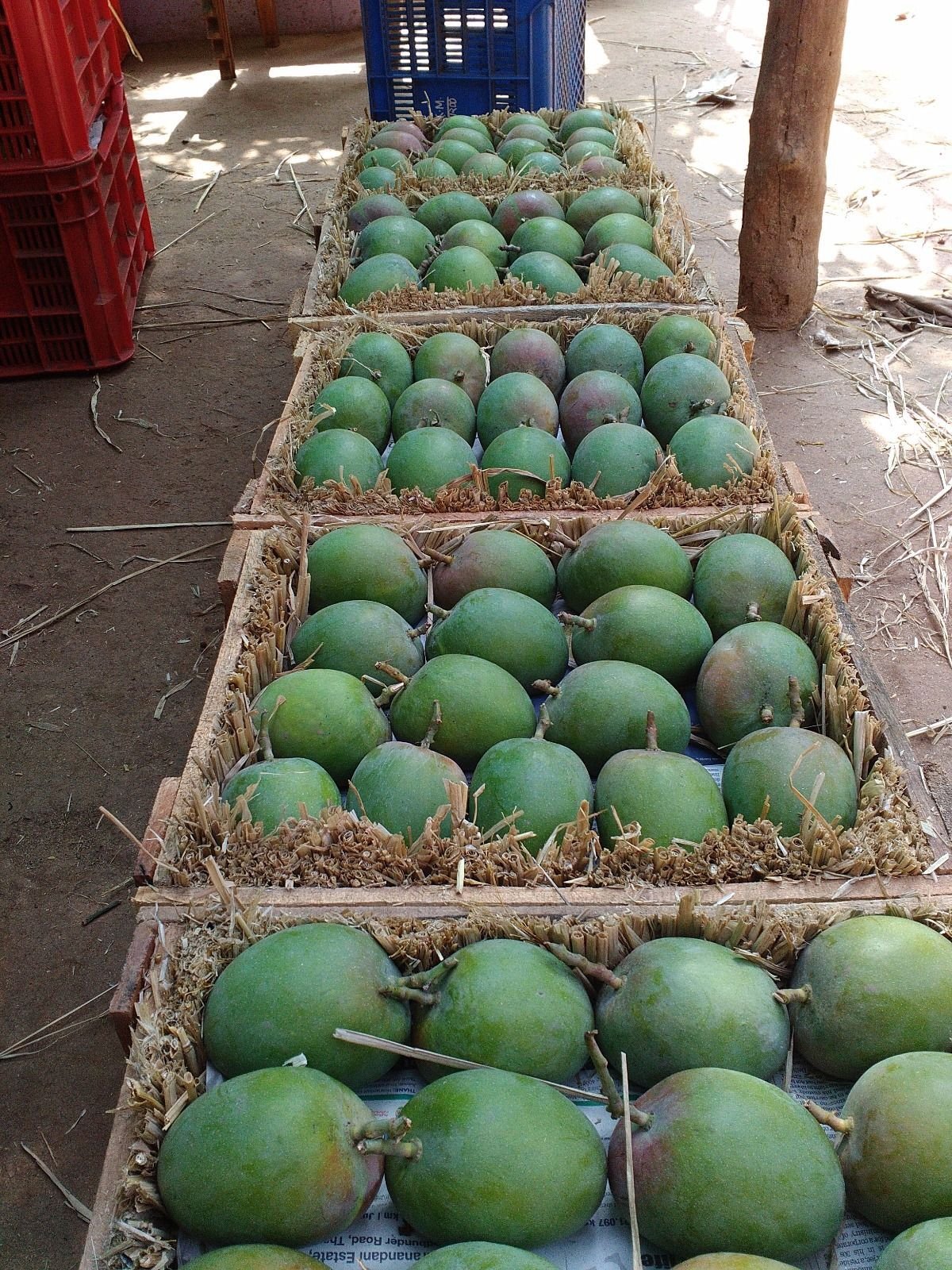
A peti of farm-direct Hapus does not arrive ready to eat — it arrives ready to ripen, and the last five to eight days of that journey happen in your kitchen. Get those days right and the fruit tastes the way it does standing under the tree in April.
Why farm-direct Alphonso arrives green
Every season a few customers open the carton, see hard green fruit and message us within the hour. Nothing has gone wrong. A correctly picked mango is mature but unripe: full-sized, heavy in the hand, shoulders filled out, sap dried at the stem. It has finished growing; what it has not done is turn its starch into sugar, and that happens off the tree.
We harvest at what the older generation in our village calls the tayar stage — ready, not ripe. The fruit is picked with a zela, the bamboo pole with a net, so it never touches the ground, then rested in shade for the sap to drain. Fruit left to colour on the tree is sweet on day one and pulp by day three; it would never survive a lorry from Ratnagiri to Delhi. Green at delivery is the only honest way to send a soft-skinned mango across the country, as we explain in our guide to how mangoes travel across India.
Hard, heavy, dull-green fruit with a dusty bloom is exactly what you should receive. Fruit that is already bright yellow on delivery has either been carbide-treated or spent too long in transit.
The Konkan method: gawat, husk and a closed peti
Ask anyone in Ratnagiri, Rajapur or Guhagar and you get the answer their grandmother gave: bury the fruit in dry grass and shut the box. We pack every peti with a bed of gawat, dry paddy straw, or rice husk — and not only for cushioning.
A ripening mango gives off ethylene, the gas by which the fruit tells itself to soften. In open air that gas drifts away and the fruit ripens slowly and unevenly, often shrivelling at the stem before the flesh is sweet. Inside a closed carton packed with straw, the gas stays around the fruit while the straw still lets a little air through and soaks up the moisture the mangoes release, so the mangoes ripen each other — no chemicals, no carbide, no sachets. In a city flat, crumpled newspaper does the same job, and many of our Mumbai regulars simply tip the fruit into the old steel kothi under newspaper.
Setting up your ripening box
- Open the peti the moment it arrives and look at each mango in daylight.
- Sort as you unpack. Set aside anything with a soft patch, a cut or a bruised shoulder — those ripen faster and can spoil their neighbours.
- Line a carton or basket with a thick layer of the straw that came in the peti, or three or four sheets of crumpled newspaper.
- Lay the mangoes stem-side down, not touching each other. Stem down keeps stray sap off the skin and makes the nose test easy later.
- Cover completely, and go two layers at most, with a cushion of straw between them. Never three.
- Tuck the flaps closed, never taped shut, and keep the box in a dark, dry corner away from the window and the stove.
- Check once a day at the same hour: lift the paper, smell, press gently, cover it back.
Keep the straw that came in your peti. It is clean, dry Konkan paddy straw, it has already done half the work in transit, and it will see the whole box through.
Day by day: the five-to-eight day window
These timings assume a normal Indian summer room, 25 to 32 degrees. Read it as a rhythm, not a rulebook.
| Day | What you'll see and smell | What to do |
|---|---|---|
| Day 1 | Hard, dull green, faint bloom. No aroma at all. Stony under the thumb. | Unpack, sort, set up the box. |
| Day 2 | Almost no change; perhaps a slight lightening at the stem. | Leave it alone. Do not rearrange. |
| Day 3 | Pale yellow-green creeping in at the stem and shoulders. Very faint sweetness at the stem. | Move any fruit racing ahead to the top layer. |
| Day 4 | Yellow spreading down the cheeks, aroma on opening the box, shoulders fuller. | Begin the thumb test daily. |
| Day 5 | Two-thirds gold with a saffron blush, honeyed smell, gentle give at the shoulder. | The earliest fruit is ready. Eat these first. |
| Day 6 | Most of the box gold, aroma filling the kitchen, flesh yields and springs back. | Peak eating. Chill what you cannot finish. |
| Day 7 | Deep uniform gold, skin loosening at the stem, strongly fragrant. | Finish, chill, or turn the softest into pulp. |
| Day 8 | Late or thick-skinned fruit catches up. | Give stragglers fresh straw and a day or two more. |
The four tests for readiness
Colour alone will lie to you. Use all four together and you will never cut a mango a day early.
Aroma at the stem end
The test we trust most. Hold the stem end to your nose and breathe in: a ready Alphonso smells sweet and floral, almost like warm honey and kesar. No smell means more time. A sharp, spirit-like whiff means eat it today.
Gentle give under the thumb
Press with the flat of your thumb, never the tip, on the shoulder beside the stem. You want the feel of a ripe avocado: it yields a few millimetres and comes back. Fingertip pressure bruises the flesh, and that bruise blackens by morning.
Skin colour shift
Green gives way to warm golden yellow, often with a saffron flush at the shoulder, spreading from the stem downwards. Natural ripening is uneven, so a green patch near the tip of an otherwise gold fruit is a good sign. Uniform bright yellow on day two, while the fruit is still hard and odourless, is the carbide signature; our note on how to spot real Ratnagiri Alphonso covers those marks.
Shoulder plumpness
Look at the fruit side-on. Raw shoulders are flat and angular; as the flesh swells they turn rounded and plump, and a shallow dimple appears at the stem. With aroma, this is the cue our packers use.
The refrigerator: never before, sometimes after
Never chill an unripe mango
Alphonso suffers chilling injury below about 12 to 13 degrees. In the fridge the enzymes that convert starch to sugar stop and do not restart. The skin still darkens, but it goes grey and blotchy, the flesh turns woody and sour near the seed, and the aroma never arrives. This is the one mistake with no repair.
Slowing it down once ready
After a mango passes all four tests, cold becomes your friend. A fully ripe Hapus keeps three to four days in the main compartment — never the freezer, never the coldest back shelf — and should come out half an hour before eating, since cold flesh hides the perfume. We go deeper into this in should you refrigerate mangoes.
When one runs ahead of the rest
Every peti has one. If a mango is soft and very fragrant and you cannot eat it today, do not fight it. Blend the pulp with a pinch of cardamom and no water, then serve it as aamras or freeze it flat in a bag — our family Konkan aamras recipe is written for exactly that fruit.
Staggering a peti of 24
Two dozen mangoes hitting perfection on the same afternoon is a real problem in a small family. Ripening runs on warmth and trapped ethylene, so ration both.
- Fast lane: a third of the box in straw inside a closed carton.
- Middle lane: a third in an open basket under a single sheet of newspaper — roughly two days slower.
- Slow lane: a third spread uncovered in a single layer in the coolest dark spot you have — the store room, the bottom of the almirah. Four to five extra days.
- Move fruit up the chain, never down: every second day shift two or three mangoes from the slow lane into the straw box.
- To hurry a batch, tuck in one ripe mango or a banana. Both are strong ethylene producers and pull the rest forward by a day.
Your city, your clock
Mumbai, Goa, coastal Kerala: warm and humid, closest to Konkan conditions. Expect the fast end, five to six days. Fungus, not shrivelling, is the risk here — keep the box airy and pull out any spotted fruit at once.
Delhi, Jaipur, Ahmedabad, Nagpur: hot and dry. Ripening is quick, but dry air draws moisture from the skin, so fruit can shrivel at the stem before it sweetens. Pack the straw thicker, keep the box away from cooler draughts and air-conditioned rooms, never on a terrace or in a parked car.
Bengaluru, Pune, Hyderabad: cool nights slow everything. Add a day or two to each stage, and if the room drops below 20 degrees at night move the box to the kitchen.
Kolkata and the North East: heat with heavy humidity gives fast, even ripening. Check twice daily from day four and keep the layers loose so moisture does not sit on the skin.
Common mistakes
- Sealing fruit in plastic. Plastic traps moisture along with the gas; condensation forms on the skin and black rot follows within a day. Paper, cloth, cardboard and straw breathe.
- Direct sun on a balcony to "help it along". Sun cooks one cheek soft and sunburnt while the shaded half is still raw.
- Stacking too deep. Three or four layers leaves the bottom fruit carrying a week of weight, so it reaches ripeness already bruised.
- Mixing bruised fruit with sound fruit. A damaged mango gives off far more ethylene and often carries spores at the cut; one overlooked soft fruit can take half a layer with it.
- Washing on arrival. Water on the skin during ripening invites rot. Wash just before eating instead.
- Opening the box five times a day. Every opening lets the gas escape.
At the orchard we say a Hapus tells you three times that it is ready — first with its colour, then its smell, then its softness. Wait for the second and you will never be early.
Frequently Asked Questions
My mangoes are still hard on day 8. Have I done something wrong?
Almost certainly not. Fruit from an early picking, or a peti kept in a cool room, can take nine or ten days. If the skin is firm with no soft spots, repack in fresh dry straw, move the box to the warmest corner of the kitchen and add one ripe banana.
Can I use a ripening powder or sachet?
You do not need to. The straw-and-carton method uses the fruit's own ethylene and ripens more evenly. Calcium carbide, which most market "ripening powder" is, is illegal for food use in India and gives fruit that is yellow outside and starchy inside.
One mango has a small black spot. Should I discard the layer?
No. Remove that fruit, check its neighbours for softness, and let the rest continue. If the spot is small and firm you can usually cut around it and eat the mango the same day.
Should the mangoes touch each other in the box?
Ideally not. Contact points hold moisture and are where rot begins. A finger's width of straw or paper between fruit is enough.
How do I tell over-ripe from perfectly ripe?
Three signs together: the skin wrinkles at the stem, the flesh is soft all over rather than only at the shoulder, and the aroma turns sharp and alcoholic. Such fruit still makes excellent aamras, but it will not slice well.
Order Konkan Alphonso direct from the orchard
Hand-picked, naturally ripened in hay, and packed the day they leave the tree. Message us on WhatsApp for this season's availability and prices.