
Cashew Grades Explained: What W180, W240 and W320 Actually Mean
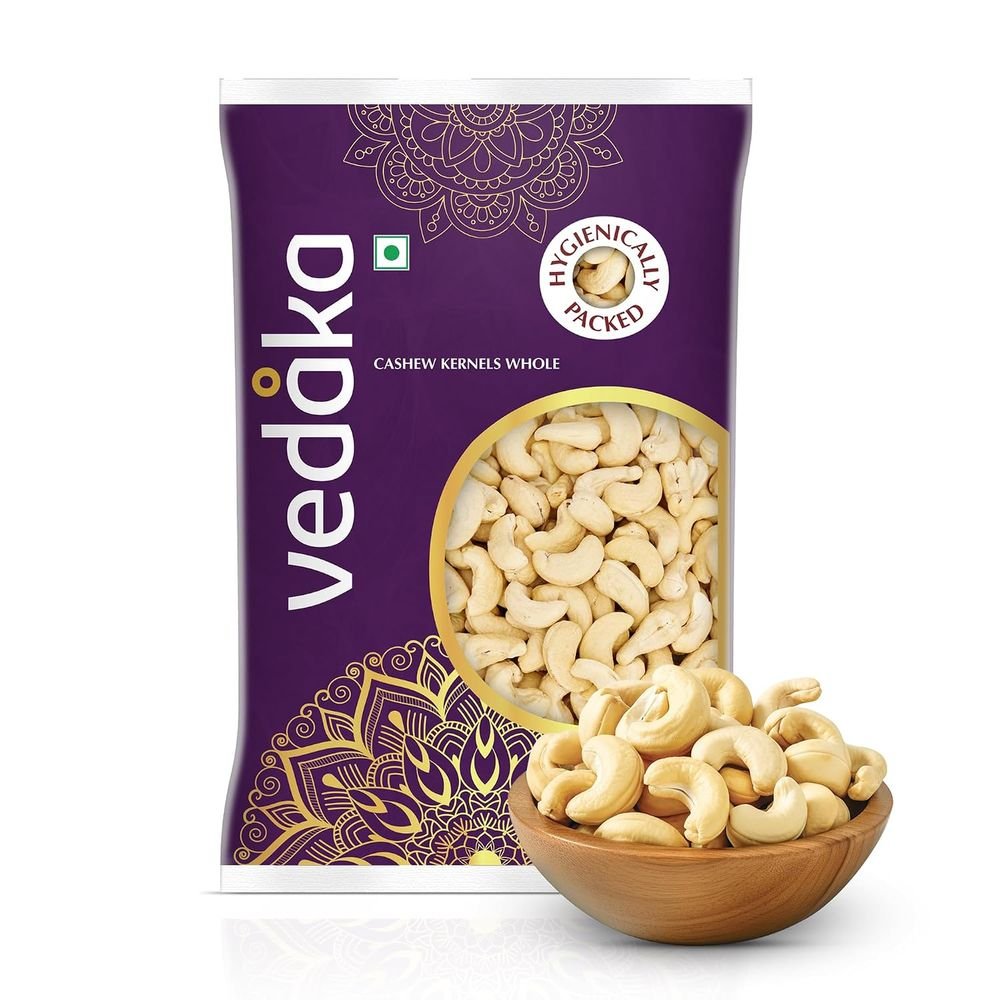
There is a code on every honest packet of cashew and almost nobody reads it. It is two characters and a number, it tells you exactly what size the nuts are, and it is checkable with a kitchen scale in about four minutes. It is also the easiest thing in the dry-fruit aisle to leave off a packet, which is why so many packets leave it off.
How the code works
Take W320, the most common grade sold in India.
The W stands for Wholes — whole white kernels, not broken, not discoloured. The number is the count per pound, which is 453.6 grams. So W320 means roughly 320 kernels make up a pound. More kernels to the pound means each one is smaller.
That is the entire system. A lower number is a bigger nut.
| Grade | Kernels per pound | Kernels per kg | In a 500 g packet | Usually sold as |
|---|---|---|---|---|
| W180 | ~180 | ~397 | About 198 | The showpiece grade |
| W210 | ~210 | ~463 | About 231 | Premium gifting |
| W240 | ~240 | ~529 | About 265 | A good gift box |
| W320 | ~320 | ~706 | About 353 | Everyday, and most "premium" hampers |
| W450 | ~450 | ~992 | About 496 | Budget whole nuts |
The check: weigh out 100 g and count it. Multiply by ten to get the per-kilo count, then compare against the table. If a packet marked W240 gives you seventy-plus nuts in 100 g, it is not W240 — it is W320 with better marketing.
The letters that are not W
This is where most of the confusion and most of the mispricing lives. W is only one of several categories, and the others are not inferior food — they are differently shaped or differently coloured food, sold at properly lower prices.
SW — Scorched Wholes. Whole kernels that browned slightly during roasting or drying. Same nut, same taste, cosmetically darker. Often a third cheaper than the equivalent W grade. For anything that goes into a curry, a masala paste or a barfi, this is the intelligent buy and nobody will ever know.
DW — Dessert Wholes. Whole but more deeply discoloured or slightly shrivelled. Cheaper again, still fine cooked.
B — Butts. Kernels broken crosswise. S — Splits. Broken lengthwise along the natural seam. Both are whole-tasting nuts that happen to be in two pieces.
LWP — Large White Pieces. SWP — Small White Pieces. BB — Baby Bits. Progressively smaller fragments, progressively cheaper.
Here is the thing worth internalising: for cooking, pieces are the correct purchase. A cashew that is going to be ground into a gravy, fried into a pulao or beaten into a sweet does not need to be whole. Buying W240 wholes to grind into a paste is throwing away the entire price premium you paid, which is for appearance.
Where it becomes a problem is when pieces are sold at whole-kernel prices. A “premium cashew” packet with no grade printed, containing a mix of splits and small wholes, priced like W240, is the most common quiet overcharge in the dry-fruit aisle.
What grade for what
W180 and W210. Genuinely large, genuinely expensive, and worth it only when the nut is going to be looked at — a gift tray, a garnish, something handed over in a box. On the tongue the difference between W210 and W320 is close to nothing.
W240. The grade a decent gift box should contain. Visibly a good nut, not an absurd price. If you are buying dry fruit for Diwali and you want the box to be honest rather than impressive, this is where to aim.
W320. The everyday grade and the one most hampers use while saying “premium” on the lid. Nothing wrong with it at all — just know that is what you are getting.
SW, splits and pieces. Everything that gets cooked. Kaju curry, pulao, barfi, ground masala, the handful that goes into a bhaji. Buy these and spend the difference on something else.
The link below is an affiliate link. If you buy through it we earn a small commission at no extra cost to you, and the price is the same either way. Full disclosure.
The point is that the grade is printed on it
The reason to pick a packet like this one over a prettier box is not that the nuts are better — W320 is the ordinary grade and the packet says so. It is that the packet says so. You know what you are buying, you can check it against the table above with a kitchen scale, and the price is being asked for a stated thing rather than for the word premium in gold type.
See graded W320 cashew on AmazonIf you are cooking with them rather than serving them, look for splits or scorched wholes instead and pay less for the same food.
Where Konkan cashew comes into it
Cashew is not native to India — the Portuguese brought it to the Konkan coast in the sixteenth century, originally to hold the laterite soil together against erosion. It took to the coast extremely well and it is now a serious crop right along it, grown in the same districts and frequently on the same holdings as Alphonso.
The regional research work at Vengurla, in Sindhudurg district, produced the Vengurla series of varieties that a large share of Konkan orchards now plant. A packet that names its district — Vengurla, Sindhudurg, Ratnagiri, Goa — is at least making a checkable claim, which is more than “premium” does.
One honest complication, because it comes up: a great deal of cashew processed in India is grown somewhere else. India is one of the world's biggest processors and imports large volumes of raw nut from West Africa and South East Asia to shell and grade. “Processed in India” and “grown in India” are not the same claim, and only the second one is about the Konkan.
Reading a packet in thirty seconds
- Is a grade printed at all? If not, that is the finding. Everything else is secondary.
- Does the pack weight match a sensible count? Use the table. This is the only hard check available to a buyer.
- Are the nuts uniform in size? Grading is a sizing operation. A bag with obvious big and small kernels mixed has not been graded, whatever the label says.
- Do they look dry and matte, or oily and limp? Cashew is about forty-six per cent fat. Oil on the inside of the packet means it has been warm for a long time.
- Smell it. Fresh cashew smells faintly sweet and milky. Rancid cashew smells like old paint, and once it does there is no fixing it.
- Vacuum-packed or nitrogen-flushed beats a resealable zip bag for anything you are not going to finish in a month.
Keeping them
Cashews go rancid, not mouldy, and they do it quietly. The fat oxidises, the flavour turns, and most people blame the brand rather than their own shelf.
Airtight, dark, and cool is the baseline — about a month at Indian room temperature before quality starts moving. In the refrigerator they hold perhaps six months, and in the freezer close to a year with no meaningful loss. They do not need thawing before use. If you buy a kilo for Diwali, freeze three quarters of it the day it arrives.
Keep them away from onions, garlic and anything dried and fishy. Nuts take on smells from across a shelf.
What this means if you are buying a gift box
Dry fruit is the default Diwali gift in most of India, and the gap between what a box costs and what is in it is wider here than almost anywhere else in the grocery aisle. Three things are worth doing.
Buy by grade rather than by packaging. A plain packet of stated W240 is a better gift than a velvet-lined tray of ungraded nuts at the same price, even though it looks like less.
Check what proportion of the box is cashew at all. Mixed trays are frequently two-thirds raisin and roasted chana by volume, which cost a fraction of what cashew does.
And if the box is being opened by someone who will cook with it rather than hand it round, the kind thing is scorched wholes and a bigger quantity. We put the rest of our thinking on this on the Diwali and gifting shelf.
Frequently Asked Questions
Is W180 better quality than W320?
Bigger, not better. The grade is purely a size sort — both are whole white kernels from the same crop, graded by how many fit in a pound. The eating difference is negligible; the price difference is not.
What does the W stand for?
Wholes — whole white kernels. SW is Scorched Wholes, which are cosmetically browned; B is butts, S is splits, and LWP, SWP and BB are progressively smaller pieces.
Are scorched cashews lower quality?
They are discoloured, not damaged. Same nut, same crop, same taste, browned slightly during processing. For anything cooked they are the sensible buy and often a third cheaper than the equivalent white grade.
How do I check a packet actually matches its grade?
Weigh out 100 g on a kitchen scale and count the kernels. Multiply by ten for the per-kilo count and compare with the table above. W240 should give roughly 53 nuts in 100 g; W320 should give about 70.
Why do some packets print no grade at all?
Because the grade would be lower than the price implies, or because the contents are a mix of grades and pieces that no single code describes. An unmarked packet is not necessarily bad food — it is an unpriced claim.
How long do cashews keep?
About a month airtight at Indian room temperature before the flavour starts to go, roughly six months refrigerated, and close to a year frozen. They turn rancid rather than mouldy, and rancid cashew smells faintly of old paint.
Order Konkan Alphonso direct from the orchard
Hand-picked, naturally ripened in hay, and packed the day they leave the tree. Message us on WhatsApp for this season's availability and prices.