
How Mangoes Travel Across India Without Bruising
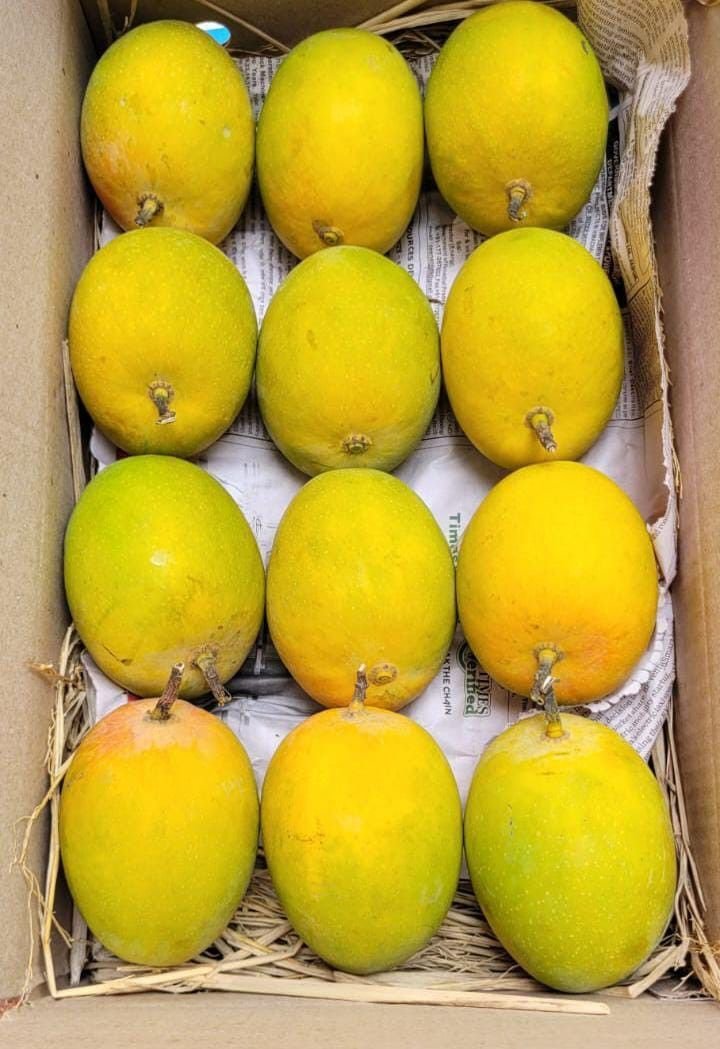
A peti of Hapus that leaves our shed in Konkan and reaches a flat in Guwahati intact has survived four handovers, two loading docks and a great deal of heat. Almost everything that decides how it arrives was settled before the box was taped shut.
Why mango is one of the hardest fruits to courier
The skin is thin and unwaxed, so it marks under pressure that would not dent an apple, and the mark does not show on day one — it surfaces three days later as a dark sunken patch, by which time nobody can say where it happened. Cut stems weep latex, and mango sap burns the skin it touches, leaving a black streak that eats into the flesh.
A ripening mango also gives off ethylene, which tells every other mango in the box to ripen, so a peti is a self-accelerating system that heat speeds up sharply. The season falls in the hottest months of the year, and most domestic parcel routes have no refrigeration. We are not shipping a product; we are shipping a living thing on a timer, through an oven.
How a peti is built to survive
The carton
A mango box is not a courier box. Ours are corrugated with enough stacking strength to hold shape under weight, because in a parcel hub our peti will not be on top of the pile. A weak carton does not tear — it bulges, and the fruit takes the load. Three-ply serves a 3 kg box travelling short; a 5 kg box to Delhi wants five-ply.
Ventilation holes
Every good mango box has vents punched on opposite walls. They release field and respiration heat, which otherwise pushes the box towards over-ripeness, and let some ethylene escape, buying a day or two. Vents on one side are useless — air needs somewhere to enter and to leave. A carton taped over its seams for "protection" is the commonest mistake we see.
What goes around the fruit
The traditional filling is gawat, dry paddy straw: cheap, breathable, absorbent of the moisture fruit gives off, and useless if it is not bone dry. Shredded paper cushions well but packs down and holds damp. Moulded pulp trays suit graded fruit, each mango in its own cavity, never touching its neighbour. Foam nets guard against abrasion but not impact. We use trays plus straw for graded fruit, straw alone for mixed sizes.
Layers, and why the box is never full
One layer travels best. Two with a straw cushion between them is our limit, the lower layer carrying the firmer, greener fruit. Three layers puts the weight of a dozen mangoes on the bottom fruit's shoulders for four days, and that fruit arrives marked whatever the carton.
A peti is packed snug but never crammed: loose fruit bruises itself over a few hundred kilometres of highway, wedged fruit bruises where it is wedged. Our test is to close the flaps, tilt the box and listen. If anything shifts, add straw. If the lid domes, take one fruit out.
Shipping to the clock: the maturity calculation
We pick against the destination. A mature Alphonso needs roughly five to eight days off the tree to ripen at room temperature, as our day-by-day ripening guide sets out, and transit eats that window. The arithmetic runs backwards: transit days, plus two or three days of ripening left for you, subtracted from the fruit's life. Longer route, greener fruit — which is why Mumbai may get fruit turning at the shoulders while Guwahati gets stone-hard green fruit from the same harvest.
| Destination | Typical transit (approximate) | Ripeness at dispatch |
|---|---|---|
| Mumbai, Thane, Navi Mumbai | 1 day, often overnight | Mature, colour just breaking at the stem |
| Pune, Nashik, Kolhapur | 1–2 days | Mature, faint yellowing at the shoulders |
| Ahmedabad, Surat, Nagpur | 2–3 days | Firm green, well filled out |
| Bengaluru, Hyderabad | 2–3 days | Firm green, well filled out |
| Delhi NCR, Jaipur, Chandigarh | 3–4 days by road or rail parcel | Hard green, dusty bloom intact |
| Kolkata, Bhubaneswar | 3–5 days by surface, 1–2 by air | Hard green, picked a shade earlier |
| Guwahati and the North East | 4–6 days by surface, 2–3 by air | Hard green, earliest safe maturity |
Treat every figure as approximate. A long weekend, a highway closure or heavy pre-monsoon rain stretches any of them.
Roads, rail parcel and air cargo
Most Konkan mango moves by road. A vehicle from Ratnagiri reaches Mumbai overnight and Pune not much later, the fruit handled only at the two ends, and road stays sensible out to roughly the Nagpur and Bengaluru distance.
Rail parcel serves the long north and east corridors and is often gentler than another day of road heat, though it adds handling at parcel offices. Beyond about three days by surface — the North East above all, Kolkata in peak heat — air cargo is not a luxury. Cutting four days to two changes the maturity we can send, so you get fruit with ripening life ahead of it rather than fruit already spent.
Heat is the real enemy
Bruising gets the blame; heat causes more losses. A metal loading dock in Nagpur or a parked tempo in Delhi at two in the afternoon is an oven, and fruit inside does not merely ripen faster — it cooks in patches, giving soft areas beneath skin that still looks green. We cannot control the hubs, so we manage the ends: packing in the cool hours, shade until pickup, evening dispatches. A peti delivered at eleven and left in a lobby or a car boot until evening can lose more in those hours than in the whole journey.
If you will not be home, ask a neighbour to take the box indoors rather than leaving it in an open lobby. Shade and moving air matter more than the exact temperature.
What happens at each handover
A box changes hands more often than buyers imagine: loaded at our shed, unloaded and scanned at the courier hub — where cartons meet concrete and weak boxes fail — loaded again for the line haul, handled at the destination hub, then given to the last-mile rider. Four to six lifts is normal, and every lift is a stranger who does not know there is fruit inside unless the box says so. Hence "FRUIT — HANDLE WITH CARE — DO NOT STACK" on the top and both long sides. A 20 kg carton gets dragged; a 5 kg carton gets carried.
The first fifteen minutes after delivery
- Take the box indoors immediately, out of direct sun.
- Photograph the sealed carton with its label, and any dents or damp patches.
- Open it at once. A peti is a ripening chamber; every hour it stays shut is ripening you did not plan.
- Unpack every fruit and lift the straw out. Do not leave a layer buried "for later".
- Inspect each mango in daylight — check the stem end and underside, press gently at the shoulder.
- Separate anything soft, split or blackened. One spoiling fruit takes its neighbours within a day.
- Lay the rest in a single layer on newspaper, stem-side down, not touching.
- Re-cover with the peti's straw if the fruit is still hard, and keep it dark, dry and off the windowsill.
- Do not refrigerate unripe fruit — cold arrests ripening for good, as our note on refrigerating mangoes explains.
- Check once daily and eat in the order the fruit ripens.
If something has gone wrong
Damage claims fail on evidence, rarely on goodwill. Photograph the unopened carton with the label readable, then the box with the flaps just opened and the fruit still in place — that shot matters most, since it shows how the fruit was packed and where the damage sits. Photograph affected fruit individually, and cut one open to show whether the flesh beneath is bruised, sap-burnt or heat-damaged. Keep the straw and carton, and send everything within twenty-four hours with a count of affected fruit out of the total.
The cause matters to an honest seller. Crushed shoulders and a caved-in carton mean handling. Uniform over-ripeness means a slow route or a hot dock. Black streaking from the stem means packing at our end — and only that last one is something we can fix in our own shed.
What is realistic, and what to ask before ordering
Nobody shipping soft fruit across a subcontinent in summer can promise perfection. In any long-distance consignment a small proportion may arrive marked, over-ripe or unusable. A fair seller says so before you order, not after you complain, and makes it right through replacement, credit or refund without arguing over a handful of mangoes.
Before ordering, ask which orchard the fruit comes from and how it is graded; the route and honest transit estimate to your city; what maturity they pick at for that distance; how many layers the peti holds; and what their damage policy is. A grower who handles their own fruit answers all five without hesitating, and the answers on picking should match what you would see in the orchard, which we describe in how Konkan orchards harvest and grade.
Frequently Asked Questions
Why did my mangoes arrive completely green and hard?
Because of where you live. Fruit going to Delhi, Kolkata or the North East is picked at the earliest safe maturity so it still has ripening life on arrival. Hard, heavy, dull-green fruit with a dusty bloom is right, and needs four to seven days in straw.
Should I keep the box closed until the mangoes ripen?
No. Open it on arrival, unpack, sort out damaged fruit and spread the rest in a single layer under the same straw. Leaving a delivered peti sealed for two more days is the commonest way a good consignment turns bad.
Is air cargo worth the extra cost for far cities?
For the North East, and often Kolkata in peak heat, yes. Cutting four or five days of surface transit to two lets the grower send fruit at a better maturity, so the difference shows in eating quality, not only speed.
What causes the black streaks on some mangoes?
Latex burn — sap from a cut stem scorches the skin, leaving a streak that later sinks into the flesh. It comes from harvesting or packing rather than transit, and is prevented by cutting the stalk long and resting fruit stem-down.
How soon must I report damaged fruit?
The same day, twenty-four hours at the outside. After two days nobody can tell whether the damage happened in transit or in your kitchen.
Order Konkan Alphonso direct from the orchard
Hand-picked, naturally ripened in hay, and packed the day they leave the tree. Message us on WhatsApp for this season's availability and prices.