
How to Cut an Alphonso Mango (and Get Everything Off the Koy)
Most mango-cutting videos are made with a firm, fibrous supermarket mango. A ripe Alphonso behaves nothing like that — it is soft, thin-skinned and full, and half the fruit ends up on the board if you treat it the same way. Here are the five cuts we actually use in a Konkan kitchen, and which one to pick for what you are making.
First, find the stone
Every mango has one flat, broad stone — the koy — and it always lies the same way: on the same plane as the flattest face of the fruit. Stand a mango on your board on its stem end and it will naturally tip onto one of its two wide sides. Those wide sides are the cheeks, and the koy is the thin wall between them.
Alphonso's koy is proportionally smaller and thinner than a Kesar's or a Badami's, which is why an Alphonso gives more pulp per kilo than its size suggests. It is also why a careless cut hurts more here — a knife that drifts into the stone on an Alphonso is throwing away better fruit.
Wash the fruit and wipe it dry before any cut. The stem end can hold traces of dried sap, and sap on the lips stings for an hour — see the sap note further down.
Method 1: the three-piece cut (the everyday one)
Best for: eating out of hand, cubes for a bowl, anything where you want neat pieces.
- Stand the mango on its stem end, stem down, flattest face towards you.
- Cut down one side of the koy, about 5 to 8 mm off centre. On a ripe Alphonso you will feel the blade graze the stone if you are too close — come out and go slightly wider rather than sawing through it.
- Repeat on the other side. You now have two cheeks and a centre slab holding the stone.
- Trim the two narrow sides off the centre slab. These strips are small but they are the sweetest fruit on the mango, closest to the skin.
A ripe Alphonso is soft enough that pressure, not sharpness, does the damage. Let the weight of the blade do the work and keep your other hand flat on top of the fruit, not gripping it.
Method 2: the hedgehog (for serving, and for children)
Best for: serving to guests, lunchboxes, getting a child to eat fruit without a bowl of juice on the floor.
Take one cheek, skin side down in your palm. Score the flesh in a grid — down to the skin but not through it — then push the skin up from underneath so the cubes splay outwards. Slice them off with a spoon or eat straight off the skin.
The catch with Alphonso: a fully ripe cheek is too soft to score cleanly and will collapse into the grid. Use the hedgehog cut on fruit that is ripe but still firm — day five or six of the ripening window, not day eight. For anything softer, skip to method 3 or 4.
Scoring with the tip of the knife, held almost vertical, gives much cleaner cubes than dragging the belly of the blade across the cheek.
Method 3: no knife at all — the hand-squeeze
Best for: ras, aamras, milkshake, anything blended — and the softest fruit in the box.
Roll the mango firmly under your palm for ten to fifteen seconds until the flesh feels loose through the skin. Nip off the stem end with your thumbnail and squeeze the pulp out like a tube of paste, working from the base up. Peel the skin back and scrape it clean with a spoon.
This is how ras is made in every Konkan house, and it wastes the least fruit of any method here — no board, no trimmings, nothing left on the skin. The full method, and why a mixer costs you aroma, is in our aamras guide.
Method 4: peel and slice (for a plate)
Best for: a fruit plate, a dessert you are photographing, gifting a cut fruit to an elder.
Peel the whole mango first with a swivel peeler, top to bottom, then cut the cheeks off the naked fruit and slice each into long petals. It is slower and more slippery than method 1 — hold the fruit with a cloth — but it is the only cut that gives you unbroken slices with no skin edge.
Method 5: firm fruit, for salad and koshimbir
Best for: mango that is ripe but still quite hard, or half-ripe fruit you want to use rather than wait on.
Firm Alphonso cuts like any other fruit: peel, cut the cheeks, then slice into batons or fine dice. It holds its shape in a koshimbir with grated coconut, green chilli and a squeeze of lime, and it does not turn to mush in a salad the way soft fruit does. Do not chill a mango to firm it up for this — chilling an unripe mango stops it ever sweetening, as our storage guide explains.
Getting everything off the koy
The stone is not waste. Squeeze it in your fist over the bowl, then scrape both faces with a spoon: two to three tablespoons per mango, which over a peti of two dozen is close to half a kilo of fruit you would otherwise have thrown out.
In our house the koy is a claim, not a leftover — whoever cuts hands it to whoever asks first, and it is sucked clean over the sink. The fibre that makes the stone annoying with a spoon is exactly what makes it good to eat this way.
| What you are making | Use this cut | Fruit stage |
|---|---|---|
| Eating out of hand, fruit bowl | Three-piece cheeks | Ripe, still firm |
| Serving guests, lunchbox | Hedgehog cubes | Ripe, still firm |
| Aamras, milkshake, kulfi | Hand-squeeze | Fully ripe to overripe |
| Fruit plate, dessert garnish | Peel and slice | Ripe, still firm |
| Koshimbir, salad, salsa | Peel and dice | Just ripe, firm |
The knife, the board and the sap
You do not need a special knife. You need a thin, non-serrated blade that is actually sharp — a serrated edge tears soft mango flesh instead of parting it, and a blunt knife makes you push, which is how a cheek turns into pulp. A small 15 cm utility knife handles mango better than a heavy chef's knife.
Use a board you do not mind staining, and wash it with cold water first: hot water sets mango stain and mango smell into a wooden board for weeks. Keep cut fruit off any board where onion or garlic has been that day — Alphonso aroma is delicate enough that it picks the onion up.
The sap matters. The milky sap at the stem end (chik) is an irritant, and on some people it raises a rash around the mouth. Orchards de-sap fruit at harvest by standing it stem-down, which is why your mangoes arrive with a dry dark stem end — but cut off the top centimetre anyway, and rinse the fruit before you cut it, especially for children.
The link below is an affiliate link. If you buy through it we earn a small commission at no extra cost to you. We link to it because we use one. Full disclosure.

A cube cutter, and where it actually helps
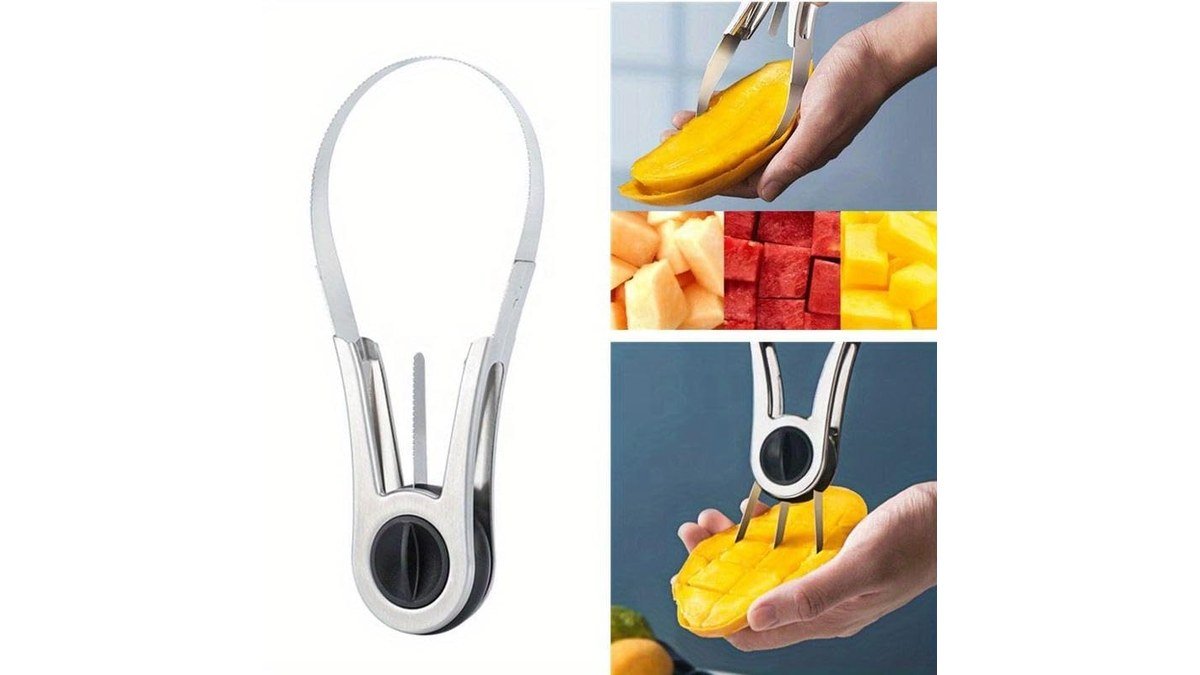
The hedgehog cut above gives you cubes for free, but it needs fruit that is ripe and still firm, and it needs a knife in your hand. This tool does both halves of that job in one piece: a thin serrated band that rides along the koy and lifts a whole cheek away, and a pronged head that dices the cheek into cubes in a single push. Useful when you are cutting a bowl for a crowd every evening in May, or when the person doing the cutting is a child and you would rather the edge were enclosed.
Its limits are real and worth knowing before you buy. A fully ripe Alphonso is too soft for the band, which tears through the flesh instead of slicing it — this is a tool for firm fruit only. The band also follows a long, flat stone better than the round, plump koy of a Hapus, so you will leave a little more behind than method 1 does; scrape the stone afterwards either way. What earns it drawer space the rest of the year is that the same cutter handles melon, watermelon and papaya, which mango season alone would not justify.
See it on AmazonCheck the blades are stainless steel rather than a moulded plastic edge, and remember Alphonso is rounder and plumper than the long, flat mangoes these tools are designed around — firm fruit presses cleanly through, soft fruit does not.
Once it is cut
Cut mango does not wait. At room temperature it is fine for two or three hours and then begins to darken and weep; in an airtight box in the fridge it holds a day, two at the outside, losing aroma the whole time. Cut only what is going to be eaten in that sitting, and if you have cut too much, pulp the rest and freeze it rather than letting it sit — freezing keeps far more of the fruit than a second day in the fridge does.
The skin is not eaten. Both skin and stone go to the compost heap, or in the Konkan straight under the tree they came from.
Frequently Asked Questions
What is the easiest way to cut a mango without wasting fruit?
For a ripe Alphonso, the hand-squeeze wastes the least — no board, no trimmings, and the skin is scraped clean. If you want pieces rather than pulp, the three-piece cheek cut plus scraping the stone gets you nearly everything; the two narrow side strips people usually discard are the sweetest part of the fruit.
Which way does the stone lie inside a mango?
Flat, along the same plane as the widest faces of the fruit. Stand the mango on its stem end and it tips onto one of those faces. Cut roughly 5 to 8 mm either side of the centre line and you clear the stone on both sides.
Can I cut mangoes ahead for a party?
A few hours at most, kept airtight and cold, and expect some darkening at the edges. Alphonso is worth cutting late — the aroma is at its peak in the first hour. For large numbers, squeeze the pulp instead and serve ras, which holds better than cut fruit does.
Why do my lips itch after eating mango?
Usually the sap from the stem end rather than the fruit. Rinse the mango, cut off the top centimetre and avoid touching the cut surface with the skin near the stem. If a reaction happens even with clean, well-rinsed fruit, that is worth raising with a doctor rather than working around.
Should I peel a mango before cutting it?
Only for plated slices or diced salad. For everything else, cutting the cheeks with the skin on gives you something to hold, keeps the flesh intact and is far less slippery — a peeled ripe Alphonso is genuinely hard to hang on to.
Order Konkan Alphonso direct from the orchard
Hand-picked, naturally ripened in hay, and packed the day they leave the tree. Message us on WhatsApp for this season's availability and prices.